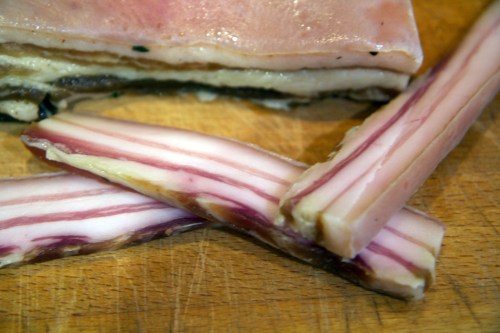
The wonderful roast pork belly we had over Christmas reminded me that pork belly is also the starting point for home-made bacon.
So I returned to Farmgate, and picked up a 1kg de-boned pork belly, as well as some tips from Melinda who runs the shop.
I had two starting points: the The art of home-made Bacon blog post by Milkwood Permaculture, and a set of instructions in Hugh Fearnley-Whittingstall’s River Cottage Meat Book. In the end, I did a blend of the two as follows:
Home-made bacon
Ingredients:
- 1kg de-boned pork belly
- 2 parts salt to 1 part sugar
- celery juice
- 2 bay leaves
- bunch lemon thyme
- 6-8 juniper berries
- 12 black peppercorns
- 2 cloves garlic
- 1.5 star anise
- 20-30 mustard seeds
Process:
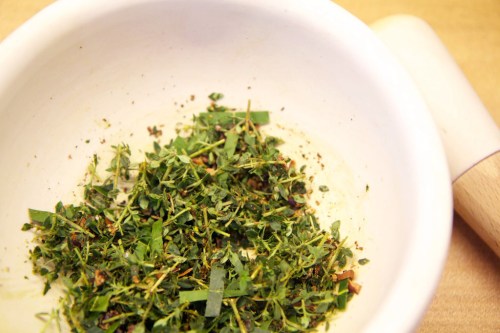
- Finely slice the bay leaves and add to a mortar and pestle with the rest of the spice mix. Lightly crush.
- Combine the salt, sugar and spice mix.
- Mix with celery juice until a damp/wet mix results.
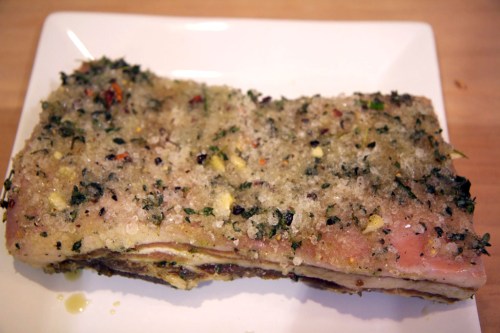
- Rub the salt mixture into the pork belly, and place in a sealed plastic container.
- Store in the fridge for 7 days.
- Remove the pork, give it a wash, and voila!

Notes:
- In commercial settings, “pink salt” is used to maintain the pink colour expected by consumers. This contains nitrates as well as food colouring. No go for an organic project!
- Celery juice is naturally high in nitrates, and this was recommended by Melinda at Farmgate and in the Milkwood blog post.
- The star anise was suggested by Melinda, as it increases the Umami in the bacon.
- You can either hot smoke the bacon (see Hugh’s book), or cook it in a 100C oven for two hours (Milkwood post).
- Or, following Hugh’s lead, you can do neither, storing it in the fridge wrapped in greaseproof paper for up to a month, and then freeze it. (This is what we’ve done.)
The result?
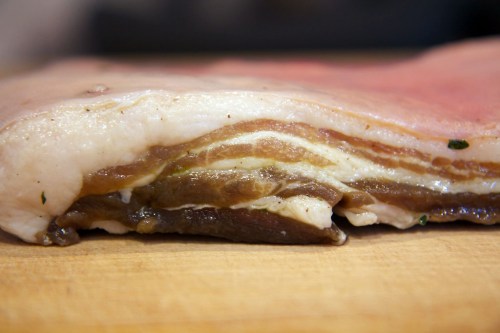
Bacon, but not like you get in the supermarket. Unlike the bland-flavoured, even-coloured commercial bacon, this is richly flavoured, salty and more-ish.
In just a week, the pork shrinks noticably in size, and becomes quite firm. The rashers are very fatty, and can be a little overwhelming if eaten “straight” with eggs and toast.
We used a thick-cut slice of bacon in home-made “split pea and ham” soup (or in our case, split pea and bacon soup). This classically thrifty soup is superb with the bacon!
Possible modifications
- The bacon was very salty and strong in flavour after 7 days of curing. For “eating” bacon, I’m going to try just 5 days of curing. For “cooking” bacon, the 7 days is perfect.
- I’m going to talk to Melinda at Farmgate about cuts of meat, to see if it’s possible to get a cut with more meat and less fat (perhaps the thicker end of the belly?). I’ll report back.
All in all, we’re declaring this experiment a success! It’s actually very simple to do, and highly recommended.


 Fire Mountain Permaculture
Leave a reply to James Cancel reply