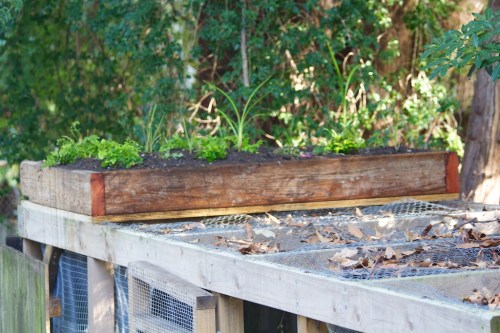
A green roof is where a garden is installed to cover a roof, typically to a depth of 150mm on top of a strong waterproofing layer. It’s a great way of getting extra greenery into a property, and the roof also asborbs water run-off.
About a month ago I stumbled across the book Small Green Roofs, on Amazon. It’s a wonderful book that has 40 different inspiring case studies, all covering small, non-commercial green roofs (full book review to come).
Feeling inspired (and running short of projects around the house), I decided to construct a green roof at the end of the chicken run.
At 1.2m x 1.6m (1.9m2), this may be Sydney’s smallest green roof.
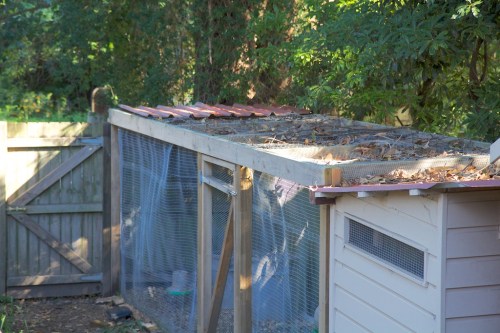
When we created the chicken run, I installed several left-over sheets of Colorbond at the end of the chicken run, to give cover for the chicken feeder (and the chickens!). This is now replaced by the green roof.
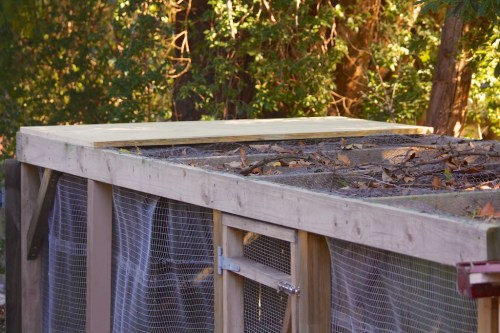
The starting point was to install a sheet of 25mm exterior-grade structural ply. This is very strong (and heavy), and it provides the base for the green roof.
The next challenge is to deal with the extra weight of the green roof. For a soil depth of 150mm, a green roof weighs 250kg per sq. m. That’s a lot!
Thankfully the chicken run was constructed strongly in the first place. To provide extra support, I installed a new vertical post (front left corner of the new green roof in the picture above). This was concreted into the ground. Extra rafters were installed, along with bracing back to existing posts.
Other than the structural ply, everything else used wood and materials salvaged locally, or left over from the house renovation.
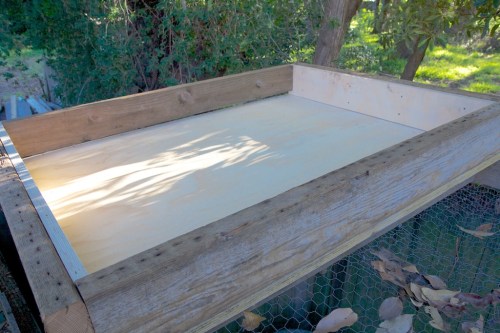
The sides of the green roof were constructed out of left-over roof beams, 200mm high. Because the sides of the wood were very uneven (from sitting in the weather for 10+ years), I put in an extra layer of ply to assist with waterproofing.
There’s a 20mm gap along the bottom edge of the green roof, to allow water to drain away.
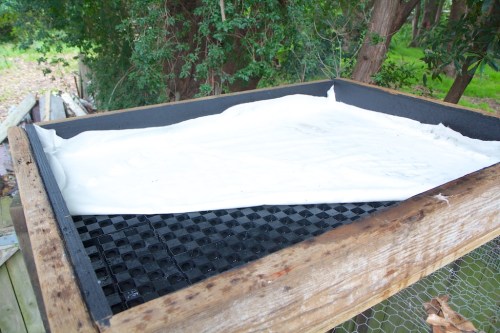
I had some left-over “pond liner” paint, so I used three coats of that to seal the base and sides of the green roof. On top of that I installed a layer of 20mm Atlantis flo-cell (left over from the reworked raised garden beds). A layer of geotextile then keeps the soil out of the drainage system.

As a stroke of luck, just as I was ready to fill the garden bed, a friend rang to ask whether I needed any soil, as he was clearing out his back garden. A ute load’s worth of soil later (courtesy of GoGet), this is the final green roof.
Green roofs would typically be planted with sedum (a low growing succulent), to cope with the extreme conditions and low water levels. In this shaded position, however, that isn’t an option.
Instead, I’ve put in some water crystals, and have planted out the garden with a mix of:
- lomandra
- dianella
- ferns
- native ground covers (native violet, white root and northern cranesbill)
Already it looks great from the back verandah, and I’ll blog new pictures in six months after (hopefully) the plants have all grown up.

 Fire Mountain Permaculture
Leave a reply to A possum ate our green roof | Lewisham House Cancel reply